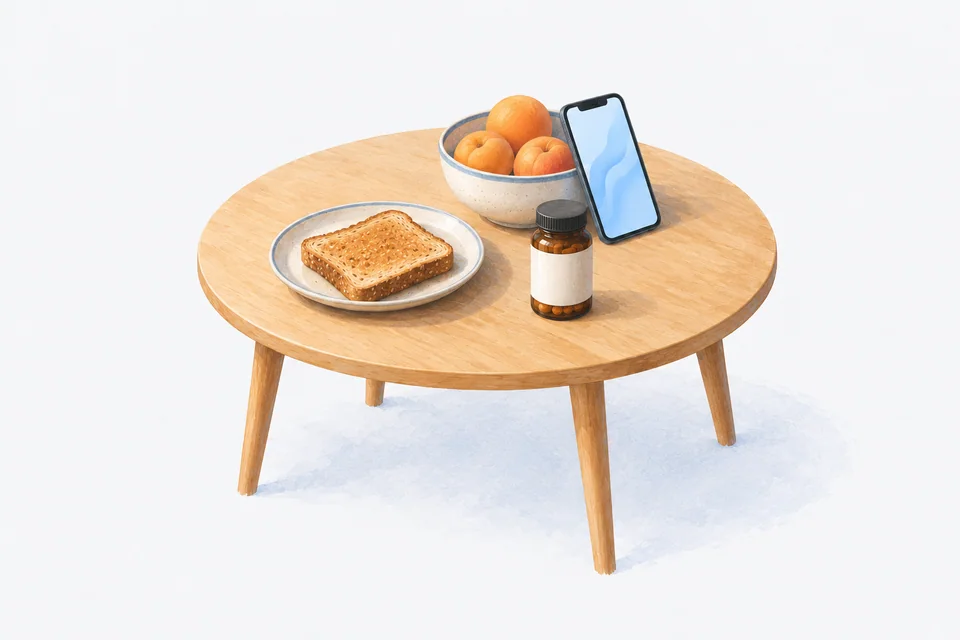
The easiest way to remember your vitamins every day is to attach them to something you already do without thinking, like breakfast or brushing your teeth, keep the jar where that happens and tick each one off when you take it. A routine built on an existing habit lasts much longer than one built on willpower.
The New Year is when many people start a vitamin or a supplement. By February, plenty of those jars are sitting at the back of the cupboard, still mostly full. The problem is rarely motivation. Missing a vitamin usually feels like nothing, so there is no cue to notice it is gone. This guide is about building the cue in.
Whether a vitamin or supplement suits you, and how much to take, is a question for your doctor, pharmacist or dietitian. This guide covers remembering the ones you have chosen.
Stack it onto a habit you already have
Habit stacking means linking a new action to an old one: "after I pour my coffee, I take my vitamin D". The old habit becomes the reminder. It works because you are not adding a new moment to your day, only a new step to one that already happens.
Good anchors share three things:
- They happen every day, including weekends and holidays.
- They happen in one place, so the jar can live there.
- They fit the label. If a vitamin should be taken with food, anchor it to a meal, not to waking up.
Common anchors that work: the first coffee or tea, breakfast, brushing your teeth at night or putting your phone on charge. Pick one, then put the jar right where it happens, as long as it is safe there and out of reach of children. Our guide to building a medication habit explains anchors in more detail.
Pick a time that suits the vitamin
Some vitamins and supplements have a preferred time or a preferred partner. Vitamin D, for example, is best absorbed with a meal or snack that includes some fat; our guide to the best time to take vitamin D covers it. Magnesium has its own considerations, set out in when to take magnesium.
Start with what the label says: "with food", "on an empty stomach" or "at night". If you take several supplements, or any prescription medication, ask your pharmacist whether any need to be kept apart. Then choose the anchor that matches. A good time you actually keep beats a perfect time you keep missing.
Start small
It is tempting to start five new supplements on 1 January. That makes it harder to remember them and impossible to tell which one, if any, is helping. Starting one at a time, a couple of weeks apart, gives each one a chance to become routine before the next arrives.
If you already take several, group them into as few time slots as possible: one morning slot and one evening slot is easier than five separate times. Our supplement stack guide shows how to sort a larger collection.
Track it, so you never have to wonder
"Did I take it today?" is the question that undoes most vitamin routines. If you are not sure, you either skip it or take another, and neither is ideal.
A simple log fixes that. Tick it off each time, on paper, in a habit app or in a medication tracker. Logging also shows you the real pattern. A vitamin you think you take every day may turn out to be four days a week, which is useful to know before you decide whether it is doing anything.
Do not double up
If you miss a day, take the next one at the usual time. Do not take two to make up for it unless your doctor or pharmacist has told you to. Some vitamins, including vitamin D and vitamin A, can build up and cause harm if you take too much over time.
It is also easy to double up without meaning to. A multivitamin often contains the same vitamins you may be buying separately, and some products contain the same ingredient twice under different names. Add up everything you take before starting something new, and show the full list to your pharmacist.
Read the units on the label
Vitamin labels use different units, and a change of brand can mean a change of unit. Vitamin D may be shown in micrograms (mcg), International Units (IU) or both. For vitamin D, 1 mcg equals 40 IU, so 25 mcg is the same as 1,000 IU. Other vitamins use different conversions.
Our free IU to mcg converter does the sum, and our guide to IU vs mg on supplement labels explains what each unit means. Check the strength every time you buy a new brand, and update your list if it changes.
Keep the jar from running out
A routine often breaks the week the jar runs dry and you do not get around to buying another. Note how many are left and reorder when you are down to a week or two, especially if you buy online. Our days supply calculator shows how long a jar will last.
When you miss a few days
Everyone does. A missed week is not a reason to stop. Pick the routine back up at the next anchor, without making up the missed days. If you keep missing the same slot, the anchor is the problem, not you. Move the vitamin to a moment that happens more reliably.
How Cadence helps with vitamins
Cadence treats vitamins and supplements like any other medication, with no limit on how many in the free version. Set your mealtimes once and tie a vitamin to one, such as "With breakfast". Vitamins due at the same time arrive in one reminder you can tick off from the Lock Screen, a widget or your Apple Watch. Supply tracking counts down each jar and warns you before it runs out, and everything stays on your phone. For more ideas, see our vitamin reminder guide.
Frequently asked questions
What is the best way to remember to take vitamins?
Tie them to a habit you already do every day, keep the jar where that habit happens and tick them off each time.
Should I take my vitamins in the morning or at night?
It depends on the vitamin and the label. Some are best with food. Choose a meal or moment you rarely miss, and ask your pharmacist if you take other medicines.
What if I forget a day?
Take the next one at the usual time. Do not take a double dose to catch up unless your doctor or pharmacist has told you to.
Cadence is a free medication reminder app for iPhone and Apple Watch. It is not medical software and does not give medical advice. Cadence Pro is a one-time purchase, with no subscription.
