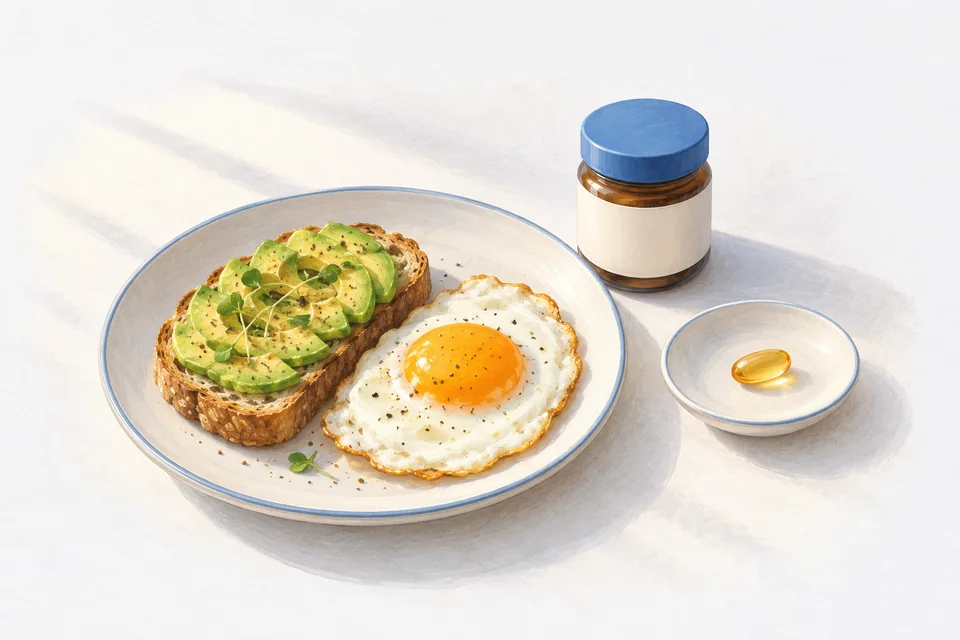
Vitamin D is fat soluble, so it is best absorbed when taken with a meal or snack that includes some fat. That is the guidance from the US National Institutes of Health (NIH). Its consumer fact sheet does not name a best time of day, so the practical answer is a regular meal you rarely miss.
This guide is about timing and remembering, not about how much to take. How much vitamin D is right for you is a question for your doctor, pharmacist or dietitian.
Why food matters
Vitamin D is absorbed in the gut along with fat. Taking it with some fat in the same meal is the part the NIH guidance is specific about. It does not have to be a large meal: the fact sheet says a meal or snack.
People with conditions that limit fat absorption, such as Crohn's disease, coeliac disease or ulcerative colitis, can also have trouble absorbing vitamin D. If that is you, talk to your doctor about it.
Morning or night?
The NIH consumer fact sheet gives no preferred time of day. What it does give is the link with food, so pick the meal that suits you:
- Breakfast: a good choice if you eat it every day and it includes some fat.
- Lunch: handy if your mornings are rushed.
- Dinner: works if it is your most regular meal.
If you take other medicines or supplements, ask your pharmacist whether any of them need to be kept apart from your vitamin D or from food. That can decide the slot for you.
Medicines to mention
The NIH lists several medicines that can interact with vitamin D supplements:
- Orlistat: can reduce how much vitamin D you absorb.
- Statins: might not work as well alongside high-dose vitamin D.
- Steroids such as prednisone: can lower vitamin D levels in the blood.
- Thiazide diuretics: could raise blood calcium too high when taken with vitamin D supplements.
This is not a full list. Tell your doctor and pharmacist about every medicine and supplement you take, and do not change anything without asking them. A medication list makes that conversation easy.
Check the numbers on the label
Labels may show micrograms, International Units or both. For vitamin D, 1 mcg equals 40 IU, so 25 mcg is the same as 1,000 IU. Our free IU to mcg converter does the sum, and our guide to label units explains the rest.
More is not automatically better. Getting too much vitamin D can be harmful, and high levels are almost always caused by taking too much from supplements. The NIH sets the upper limit for adults at 100 mcg (4,000 IU) a day from all sources, while noting that a health professional might recommend more for a period of time to treat a deficiency. Count multivitamins and any separate vitamin D together.
Make it stick
Vitamin D often gets forgotten because missing one rarely feels like anything. A few things help:
- Keep it where you eat, if that is safe in your home and out of reach of children.
- Tie it to one meal, rather than a clock time that moves around.
- Use a reminder that you can tick off, so you do not have to wonder later whether you took it.
In Cadence, you set your mealtimes once and tie a dose to one, such as "With breakfast". Change the mealtime and the reminder moves too. Tap Take on the Lock Screen or your Apple Watch and it is logged with the time. For more ideas, see our guide to vitamin reminders.
Frequently asked questions
Should I take vitamin D with food?
The NIH says it is best absorbed with a meal or snack that includes some fat.
Is morning better than night?
The NIH consumer fact sheet does not name a best time of day. Choose a meal you eat regularly, and check with your pharmacist if you take other medicines.
D2 or D3?
Both raise vitamin D in the blood. The NIH says D3 might raise it higher and for longer. Your doctor or pharmacist can say which suits you.
What if I forget a dose?
Follow the advice on your product or ask your pharmacist. Do not assume it is safe to double up.
Source
Vitamin D fact sheet for consumers, NIH Office of Dietary Supplements.
Cadence is a free medication reminder app for iPhone and Apple Watch. It is not medical software and does not give medical advice. Cadence Pro is a one-time purchase, with no subscription.
