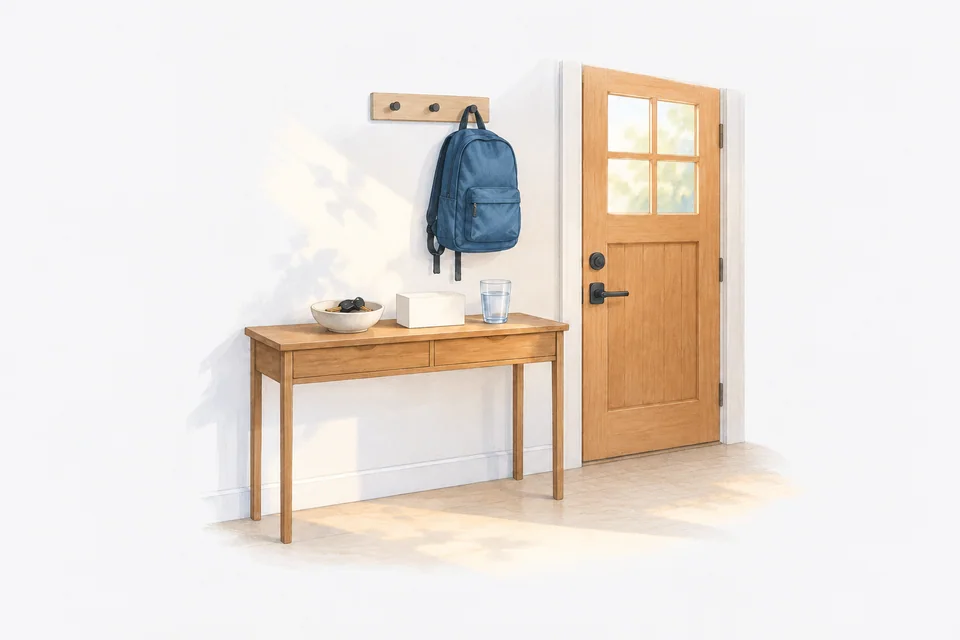
The morning dose is the hardest one for many people with ADHD, because it has to happen before the medication that helps with remembering has started working. The fix is not more willpower. It is a morning that makes the dose the easiest thing to do and leaves a record you can check later.
This guide focuses on the first hour of the day. For broader routines across the whole day, see our ADHD medication routines guide. Nothing here is advice about which medication to take or when; your prescriber sets that. This is about making sure the plan you already have actually happens.
Why mornings are different
Most reminder advice assumes you will see a notification, think "yes, right" and act on it. Early in the morning, before medication has started to help, a few things work against that:
- Your phone is full of other things. The alarm, messages that arrived overnight, the weather, the news. A medication reminder is one notification among twenty.
- You are moving between rooms. Bedroom, bathroom, kitchen, car. If the medication lives in one room and you are in another when the reminder fires, it waits.
- Time is short and uneven. Some mornings are slow, some are a sprint. A routine that only works on slow mornings will fail on the days that matter most.
- The memory is foggy later. By mid-morning, "did I take it?" is a real question, and guessing wrong either way is a problem.
Put the medication on your path, not in a cupboard
The single most useful change is physical. Work out the one spot you pass every morning without fail, then put the medication there.
- Next to your keys or wallet. You cannot leave without them, so you cannot leave without seeing the medication.
- Beside the kettle or coffee machine. If coffee happens every day, attach the dose to it.
- On the bathroom shelf next to your toothbrush. If brushing your teeth is automatic, use it.
Check the label for storage instructions first. Some medication needs to stay away from heat or steam, and anything stored in a shared space should be out of reach of children. If the obvious spot is not suitable, keep an empty reminder object there (the box without the blister, for example) and the medication itself somewhere safe nearby.
Have water already there
A surprising number of morning doses are delayed by "I'll take it when I get a drink". Leave a glass or bottle next to the medication the night before. One less step is one less chance to drift.
Set the reminder for when you are actually there
If your alarm goes at 6:30 but you reach the kitchen at 7:10, a 6:30 reminder fires while you are still in bed. Set it for the moment you are standing next to the medication. Watch your real mornings for a week and adjust.
Some people find two reminders work better than one:
- A first reminder at the usual time.
- A follow-up 20 to 30 minutes later if the dose has not been logged.
The follow-up is the important one. On a smooth morning you never see it. On a messy one, it catches you in the car park before you have driven off.
Log it the moment you take it
The log is what answers "did I take it?" at 11 am. Make logging part of the same action as taking the dose:
- From the Lock Screen notification. Tap Take without unlocking.
- From your watch. A tap on the wrist while the glass is still in your other hand.
- From a Home Screen widget. If you open your phone for the weather anyway, the widget is right there.
Avoid "I'll log it later". Later is when you will not remember whether you did it. Our guide to answering did I take my medication? goes further on this.
Give yourself a sensible window
Very few mornings run to the minute. A dose window treats a dose taken shortly after the set time as on time. If your prescriber is happy with a range, set the window to match it. That way a reminder that fires at 7:00 and a dose at 7:25 still reads as a good morning, not a late one.
If you are not sure how much flexibility your medication allows, ask your pharmacist. Some medication is fine within a few hours; some is meant to be taken at the same time each day; some affects sleep if taken too late. That is a question for them, not for an app.
Plan for the off-script mornings
Weekends, early flights, sleep-ins and sick days break routines. A little planning helps:
- Weekends. If you get up later, consider whether a later reminder makes sense on those days, or keep the same time and use the follow-up. Check with your prescriber if you are thinking of changing timing.
- Travel and early starts. Pack the medication the night before, with water, in the bag you will definitely take.
- Staying elsewhere. Put the medication with your phone charger. You will look for the charger.
How Cadence helps in the morning
Cadence reminders arrive as Time Sensitive notifications with Take, Skip and Snooze on the Lock Screen. Follow-ups repeat if the dose is still unlogged. Each dose is saved with the time you took it, so you can check later. Dose windows are adjustable, Apple Watch logging works from your wrist, and Home Screen and Lock Screen widgets show what is next. It is free, with no account and no subscription.
Frequently asked questions
Should I take ADHD medication at the same time every morning?
Ask your prescriber or pharmacist. Timing depends on the medication and on you. An app can help you stick to a time; it cannot choose one.
What if I realise at lunch that I forgot?
Check the leaflet and ask your pharmacist if you are unsure. Do not double up to catch up. Our missed dose guide explains the general questions to ask.
Does a smartwatch help?
For many people, yes. A tap on the wrist is harder to ignore than a banner on a phone in another room, and logging from the watch takes a second.
Cadence is a free medication reminder app for iPhone and Apple Watch. It is not medical software and does not give medical advice. Cadence Pro is a one-time purchase, with no subscription.
