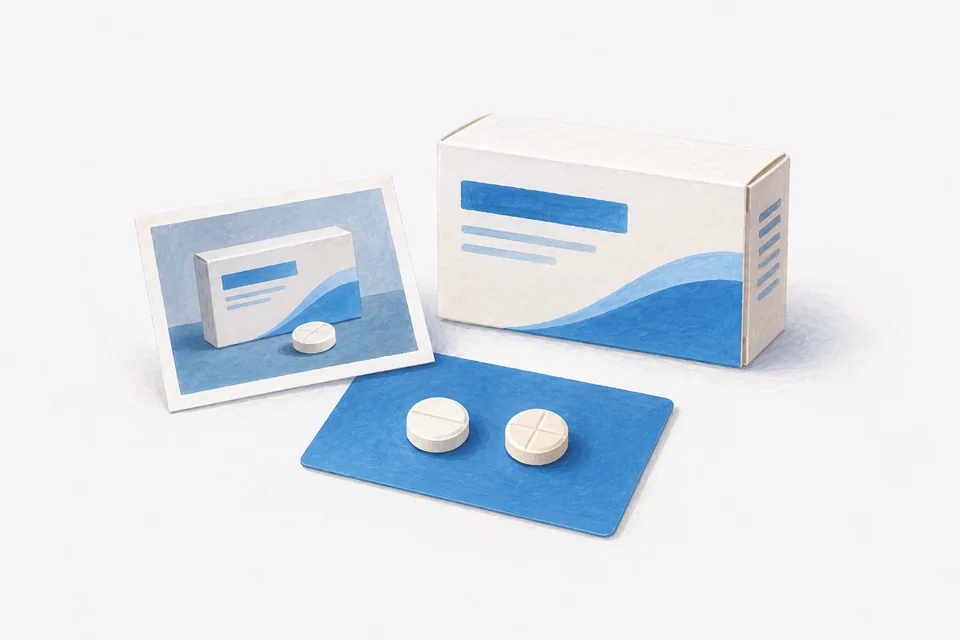
1.5 tablets means one and a half tablets: one whole tablet plus half of another, taken together as one dose. It is not half a tablet. Half a tablet is 0.5, often written ½. Only split a tablet if it is made to be split, usually with a break line across the middle, and never split a modified-release or enteric-coated tablet unless the label or your pharmacist says you can.
Fractions on a medicine label are easy to misread, especially on a new prescription or when the dose has just changed. Below is what each one means, how to tell if a tablet can be split and how to split it well.
Tablet fractions at a glance
| On the label | Means | Tablets to take |
|---|---|---|
| 0.25 or ¼ | A quarter of a tablet | One quarter |
| 0.5 or ½ | Half a tablet | One half |
| 1 | One tablet | One whole |
| 1.5 or 1½ | One and a half tablets | One whole plus one half |
| 2 | Two tablets | Two whole |
| 2.5 or 2½ | Two and a half tablets | Two whole plus one half |
So "take 1.5 tablets twice a day" means one and a half tablets in the morning and one and a half in the evening, 3 tablets a day in total.
Doses in mg and half tablets
Sometimes the prescription is in mg and the tablet strength doesn't match. Divide the dose by the tablet strength:
Tablets per dose = dose in mg ÷ mg in one tablet
- Half of 1 mg is 0.5 mg. If your dose is 0.5 mg and your tablets are 1 mg, that is half a tablet.
- A dose of 7.5 mg with 5 mg tablets is 1.5 tablets.
- A dose of 25 mg with 50 mg tablets is half a tablet.
Our free tablet count calculator does this sum, including halves, and works out how many tablets a course needs. If the answer is a fraction your tablets can't be split into, such as a third, ask your pharmacist. There may be a different strength that makes the dose a whole tablet.
Which tablets can be split
A tablet can usually be split when all of these are true:
- It has a break line, a groove pressed across the middle.
- The leaflet says it can be divided into equal doses. In Australia this is the Consumer Medicine Information (CMI) leaflet, and in the UK the patient information leaflet. Some break lines are only there to make a large tablet easier to swallow, not to split the dose. The leaflet tells you which.
- Your doctor or pharmacist has told you to take part of a tablet.
The NHS Specialist Pharmacy Service, Australian Prescriber and the US FDA all point the same way: check the product information or ask a pharmacist before splitting, because a break line alone isn't a promise that both halves hold the same dose.
Tablets you should not split
Don't split, crush or chew these unless the label or your pharmacist says it's safe for that exact product:
- Modified-release tablets. These release the medicine slowly over many hours. Look for letters after the name such as MR, SR, XR, ER, CR, CD, LA or XL. Splitting one can release too much medicine at once.
- Enteric-coated tablets, often marked EC. The coating protects the tablet from stomach acid, or your stomach from the medicine.
- Capsules. Don't open them unless you've been told to.
- Tablets with no break line, unless your pharmacist says otherwise.
- Some medicines that shouldn't be handled at home, such as certain cancer and hormone medicines. Your pharmacist can tell you if yours is one.
If a dose needs a half tablet of something that can't be split, ask the pharmacist about a lower strength, a liquid or having the pharmacy prepare the halves for you.
How to split a tablet with a pill splitter
A pill splitter is a small plastic box with a blade in the lid and a V-shaped holder underneath. Most pharmacies sell them, and they give much more even halves than a kitchen knife.
- Wash and dry your hands.
- Open the splitter and place the tablet in the V, with the break line lined up under the blade.
- Close the lid firmly in one press.
- Take the half you need. Put the other half back in the original pack, not loose in a pill box for days, unless your pharmacist says that's fine.
- Use the other half for the next dose, before starting a new tablet.
- Wipe the blade and holder clean so dust from one medicine doesn't end up on another.
If halves keep coming out uneven or crumbly, tell your pharmacist. For some medicines, small differences matter.
Keeping track of part tablets
When a dose is 1.5 tablets, the box runs out sooner than you might expect: a box of 30 at 1.5 a day lasts 20 days, not 30. In Cadence you can set the quantity for each dose to 1.5 tablets and, if you add how many tablets you have, it takes off exactly 1.5 each time you log the dose, so its days of supply and refill reminders stay right. If you only take half of a usual dose one day, choose Log half dose from that dose's menu and half is taken off.
Frequently asked questions
What does 1.5 tablets mean?
One and a half tablets: one whole tablet plus half of another, taken together as one dose.
Is 1.5 tablets the same as half a tablet?
No. Half a tablet is 0.5. 1.5 tablets is three halves, three times as much as half a tablet. If you're unsure which your label means, ask your pharmacist before you take it.
What is half of 1 mg?
0.5 mg. If your dose is 0.5 mg and your tablets are 1 mg, the dose is half a tablet, as long as the tablet can be split.
Can I cut a tablet without a break line?
Only if your pharmacist says it's fine for that medicine. Tablets without a break line may not split evenly, and some, such as modified-release and enteric-coated tablets, can be harmful if split.
Where do I get a pill splitter?
Most pharmacies sell them. Ask the pharmacist to show you how to line up your tablet, and whether your medicine is safe to split at all.
Cadence is a free medication reminder app for iPhone and Apple Watch with unlimited medications and no account required. It is not medical software and does not give medical advice. Cadence Pro is a one-time purchase, with no subscription.
